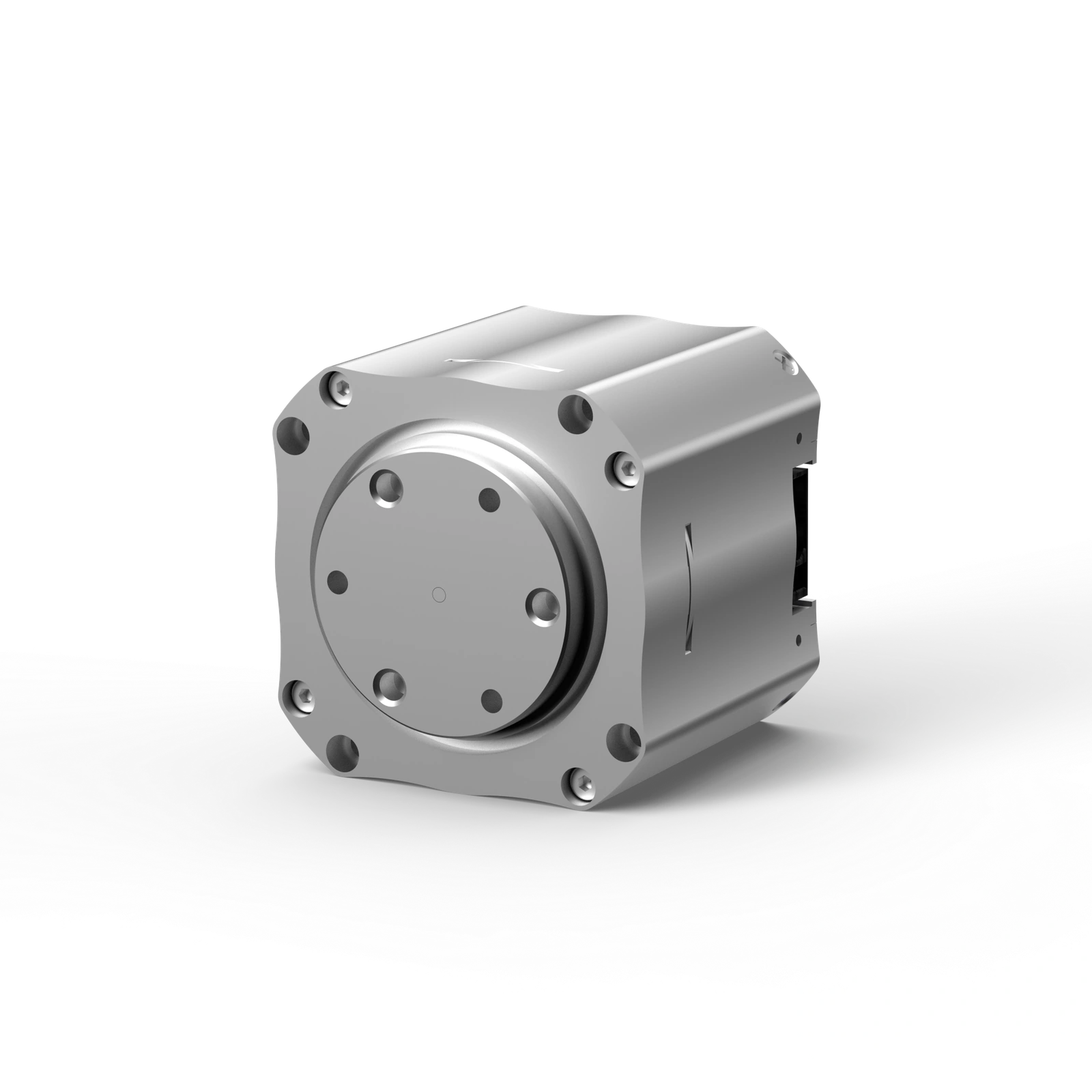
XTR-J107 product view

View full-size image ↗ · 2104 × 2104 px
Product image. Confirm the selected configuration before ordering.

Rated torque
10 N·m
Rated speed
50 rpm
Weight
565 g
HOTPlanetary Joint Module

XTR-J10710 N·m Robot Joint Actuator

XTIVOR XTR-J107 is a 10 N·m planetary robot joint actuator for teams comparing hardware for custom robotic arms and articulated research mechanisms. It lists 50 rpm rated speed, CAN FD / CAN communication and a 565 g module weight.

USD 300+Indicative guide price / unit

Rounded guide prices help you plan. Exact pricing depends on configuration and quantity. Confirm availability, lead time, taxes and shipping with your quote.

Questions about this model? Email our sales team.

Catalog specifications · page 13
CUSTOM ARMS & ARTICULATED RESEARCH

Plan the load at each robot joint.

Consider XTR-J107 when your load analysis points toward the 10 N·m rated-torque class. The right joint depends on the complete mechanism: link lengths, tool offset, working poses and acceleration all influence the operating point. Use the catalog specifications to build a shortlist, then check your motion cycle against the torque-speed curve.

MANIPULATION PROTOTYPES

Account for the tool and links

For a custom robotic arm, include the gripper, fixture and carried object together with downstream links and actuators. Review the load across the intended working poses before assigning J107 to a particular axis.

Explore custom robot joints →
MECHANICAL INTEGRATION

Balance torque, size and mass

The catalog lists a 60 mm length-and-width dimension and 56 mm height. At 565 g, J107 adds 242 g compared with J105; include that change in upstream joint calculations and check the mounting interface in the drawing.

View installation dimensions →
MULTI-AXIS DEVELOPMENT

Scope a shared controller

Plan the CAN FD / CAN network around your axis count and required feedback. Confirm message formats, addressing, update timing and supported modes for the delivered hardware before selecting the host interface.

Review communication requirements →
READ THE OPERATING CONDITIONS

Keep rated, stall and no-load values separate.

XTR-J107 lists 10 N·m rated torque and 50 rpm rated speed, with a 36:1 reduction ratio. The catalog separately lists 36 N·m stall torque and 60 rpm no-load speed. Those figures describe different conditions and cannot be combined into one operating point.

For repeated motion or extended holding, discuss your duty cycle and cooling arrangement with XTIVOR. Review the rated-versus-stall torque guide and the curve below before finalizing a joint.

TECHNICAL DATA

Specifications

Mechanical
ParameterValue
Length and width60 mm
Height56 mm
Weight565 g
Module Performance
ParameterValue
Reduction ratio36:1
Rated voltage24 V
Rated current3 A
Rated torque10 N·m
Stall torque36 N·m
Rated speed50 rpm
No-load speed60 rpm
Rated output power52 W
Motor
ParameterValue
Torque constant0.531 N·m/A
Pole pairs14
Electrical And Control
ParameterValue
Voltage range12 to 50.4 V
Peak current15 A
Speed control accuracy±10%
Torque control accuracy±10%
CommunicationCAN FD / CAN
Response time140 µs
Input encoder resolution14 bit
Output encoder resolution14 bit
Bus bit rate5 Mbps
Control frequency3 kHz
Gearbox
ParameterValue
Backlash<10 arcmin
Positioning repeatability<12 arcmin
Absolute positioning accuracy<15 arcmin
XTR-J107 torque-speed curve
Torque-speed curve
XTR-J107 installation dimensions
Installation dimensions
6, 10 OR 18 N·m?

Choose torque with the whole arm in mind.

J105, J107 and J110 all list 50 rpm rated speed, while their rated torque and weight differ. J107 occupies the 10 N·m position in this shortlist. A move to a larger module also changes packaging and the load carried by upstream axes.

Catalog specifications for initial selection
ModelRated torqueRated speedWeight
XTR-J1056 N·m50 rpm323 g
XTR-J107 Your selection10 N·m50 rpm565 g
XTR-J11018 N·m50 rpm850 g

Review individual installation drawings, allowable external loads and operating conditions before changing models. These modules are not established as mechanically interchangeable.

FROM SHORTLIST TO INTEGRATION

Questions before you order

What payload can a 10 N·m robot joint lift?

A torque rating alone does not define a payload in kilograms. Required torque depends on the load's distance from the joint, orientation, tooling, link mass and acceleration. Send a load diagram and representative working poses when discussing J107 for your mechanism.

Can J107 provide 36 N·m at 50 rpm?

The catalog does not establish that operating point. It lists 36 N·m as stall torque, separately from 10 N·m rated torque and 50 rpm rated speed. Use the torque-speed curve and confirm thermal and duty-cycle limits for your intended operation.

What should I check before designing the mount?

Use the J107 installation drawing to check the mounting pattern, output interface and available clearance. Confirm permissible axial and radial loads for the delivered configuration; torque and package dimensions alone do not establish those load limits.

What do I need for controller and software integration?

The catalog lists 24 V rated voltage, CAN FD / CAN and 14-bit input and output encoders. Request the connector pinout, command protocol, feedback details and current requirements. Include your software stack in the inquiry: ROS or LeRobot compatibility has not been verified for this module.

How do prototype and volume quotations work?

USD 300+ per unit is an indicative guide price. Specify the quantity for your first build and expected volume, along with the required configuration and destination. Ask for an exact quotation covering availability, lead time, shipping and taxes.

PLAN YOUR NEXT BUILD WITH XTIVOR

Discuss your 10 N·m joint requirements.

Share your mechanism, load diagram, target speed and planned quantities. Include mounting constraints, controller requirements and delivery destination for a configuration-specific or volume quotation.

SELECTION HELP

Plan your next step

All guides
CONTINUE EXPLORING

Related products

View category